

![[The Lunch Table] Dubai Chocolate Syndrome: When You Try to Be Everything at Once](https://qhsscardinalchronicles.com/wp-content/uploads/2026/02/the-lunch-table.png)
![[The Lunch Table] Milk before cereal? School life over social life?](https://qhsscardinalchronicles.com/wp-content/uploads/2026/02/screenshot-2025-10-17-at-9.26.03-pm-1200x1198.png)








A QHSS student’s average day closely mimics one of any other high schooler’s in the nation; walking through the halls with friends, going to class to sit in the same seat you’ve sat in all semester, watching a short lesson, and completing the work assigned. But hidden within this average schedule lies a secret: the reason that rates of girls demonstrating interest in engineering are so low in QHSS, even compared to other schools across the country.
A Look into the Main Course of the Engineering Department
There wasn’t always a gender gap in the QHSS engineering department. All students in QHSS experience Regents Physics during their sophomore year as a prerequisite to achieving their high school diploma. However, even though the mandatory course should encourage girls to pursue engineering and reduce any gender disparities, the percentage of girls in higher-level engineering classes still drops as low as 20% in AP Physics C: Mechanics. So, what happens from the day a sophomore starts Regents Physics, to the day when the sophomores and juniors choose their classes for the following year that causes this disparity?
On most days, Regents Physics is a pretty traditional STEM class. Our physics teachers Dr. Gustafson and Mr. Su teach their respective classes through slide decks to demonstrate concepts and provide practice questions to prepare for the city-administered test in June.
Physics is an objectively challenging course because of the conceptual nature of the subject and the intense mathematical thinking required. Yet, Physics’s observable nature poses an advantage that allows the course to be accessible and entertaining.
Once every few weeks, the QHSS Physics teachers provide all their students with simple objects, such as marbles, rubber bands, spring scales, and stopwatches. Suddenly, the physics classroom transforms from a place of routine practice drills to a bustling room where formulas jump out of notebooks into the real world.
Junior Alyana Enderes recalls, “I found the labs really helpful last year in helping me understand the concept because I was able to actually visualize the concepts we were learning. I can’t really do that with just the slides.” With the collaborative nature of these labs, students often found a community in their classes. Junior Hemani Gaikwad added on, “I found it educating to analyze data I found in a partner or group setting.” Despite the strenuous Regents Physics curriculum, the labs act as a haven for students. These labs are a gateway for every student to participate in the class and find a support system within their tables, even for the students who struggle to grasp information from a traditional slide deck.
If these courses foster such a supportive and collaborative environment for its students, why does a gender disparity in our school persist?
Uncovering the Gender Disparity
At QHSS, students come from various backgrounds and experiences. However, boys are more likely to have been pushed towards STEM by parents and teachers. Additionally, the lack of female mentors in STEM creates a cycle with fewer females entering these STEM classes with less prior experience and less confidence. The effects of this confidence gap are evident in STEM classes, especially collaborative efforts such as labs. For example, female students may be less likely to feel comfortable leading discussions, contribute to labs, and bounce back from being wrong.
The confidence gap is often intensified by an already unwelcome and sometimes exclusionary environment. Even a seemingly small action such as failing to offer help to a confused classmate can multiply the existing confidence gap, making female students feel even more out of place.
Furthermore, in a competitive STEM school such as QHSS, most students were likely encouraged toward STEM. However, the confidence gap persists, often magnifying the disparities between boys and girls. For example, although there’s high enthusiasm for STEM in all students, female students may be more likely to feel uncomfortable leading or after making mistakes, creating an environment where male students can easily overshadow their female peers.
But it isn’t just the confidence gap at play – these issues are often intensified by an already unwelcoming and sometimes exclusionary environment. In settings where male students dominate discussions or implicitly question female contributions, the existing lack of confidence can multiply, making female students feel even more out of place and discouraged from fully engaging. This dynamic further reinforces the disparity, creating an environment that feels closed off to many female students from the start.
This unfortunate, uncomfortable, and sometimes reportedly hostile environment is the face of the gender disparity in STEM. With multiple female students in our school pointing their fingers towards feeling discouraged in their classes as the culprit of their disengagement from these subjects, as well as research studies such as one conducted at Pew Research Center demonstrating perceived gender discrimination in the STEM field is the cause for women refusing to enter the field, it’s more important than ever for students in QHSS to make a conscious effort towards closing the confidence gap and ending gender discrimination.
Behind the Doors of AP Physics C
QHSS’ only AP Physics course, AP Physics C: Mechanics, has an average of just eight female students out of classes of about thirty.
With the AP test being in May as opposed to the Regents which are tested in June, and the additional difficulty of the coursework, the pace of the AP class is definitely heightened. Additionally, AP Physics C has a large amount of mathematical concepts of greater difficulty, making the course itself much more challenging.
With a course so challenging and fast-paced, the need for a community is greater than ever. With so few girls in these classes, it’s much less likely for a female student to find a support system of classmates who share their backgrounds and perspectives. Combined with the reduced number of labs due to the amount of content in the class that needs to be covered by May, with Dr. Gustafson’s class doing about a lab every two weeks and Mr. Su’s class doing a lab every few months, it’s that much harder for female students to find the community needed to foster confidence in STEM.
The Face of Gender Disparities in the Hands of QHSS Student Leaders
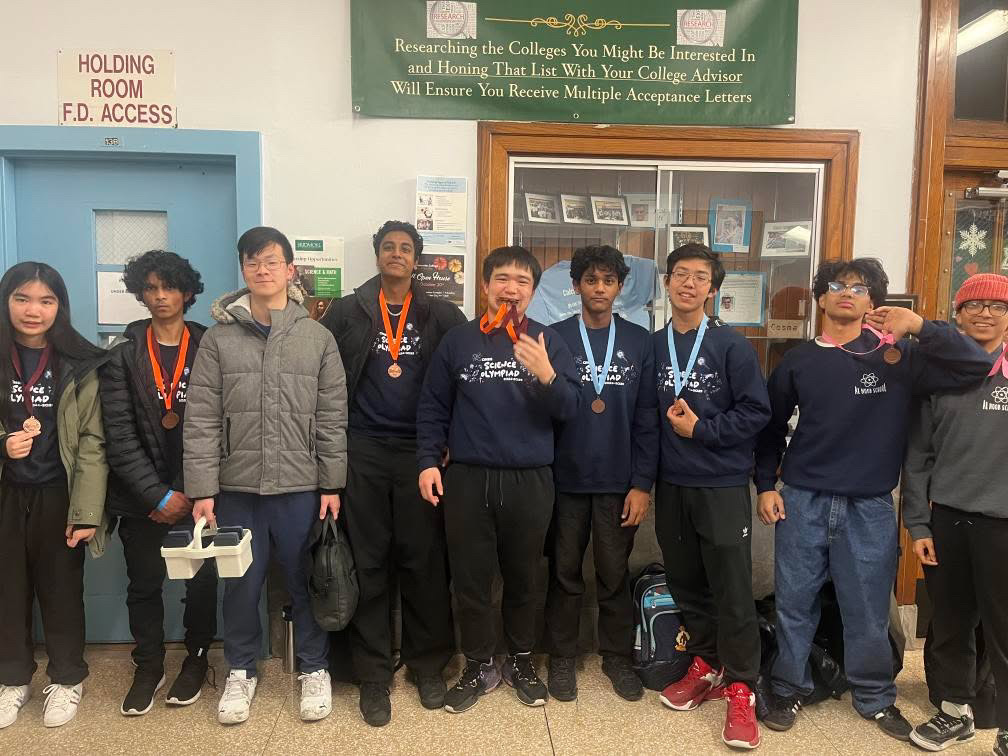
QHSS’ Science Olympiad team is one of QHSS’ two competitive STEM teams. SciOly allows its members to study a vast range of subjects, or “events”, from the engineering of a tower to learning astronomy. For the most part, these events can be divided into paper testing events, lab or hands-on events, and building or engineering events.
The non-engineering portions of Science Olympiad are collaborative by nature, notes Andrew Han. Andrew Han is a returning member of Science Olympiad and acted as an event lead for Chemistry Lab last year, an event where students were expected to perform and make conclusions from titration experiments. He recalls “Even though we didn’t have enough materials for everyone to perform titrations during every meeting, everyone would at least have the chance to set up and clean up the lab equipment every meeting. I got this idea from reading the rulebook since everyone would have to split up into teams of 2 during the regional, so I knew everyone had to be familiar with using the lab equipment.”
These protocols set by the Science Olympiad competition, such as having smaller teams during competitions and encouraging the creation of the role of event lead who ensures all members understand the information needed for each event, protect their clubs from experiencing or elevating inequity. In the hands of student leaders who seek fairness in collaborative tasks, these protocols are the difference between an environment that’s full of passion and learning and an environment that’s hostile.
With the labs in our school being the center stage for collaboration, and by extension, an inequitable environment, it’s vital for students in our school to put just as much thought into decreasing inequity. Whether you take a page out of Science Olympiad’s book by ensuring equal collaboration and ensuring your table mates all understand the material, or something completely different, any progress made in labs would mean progress in terms of equity in our school.
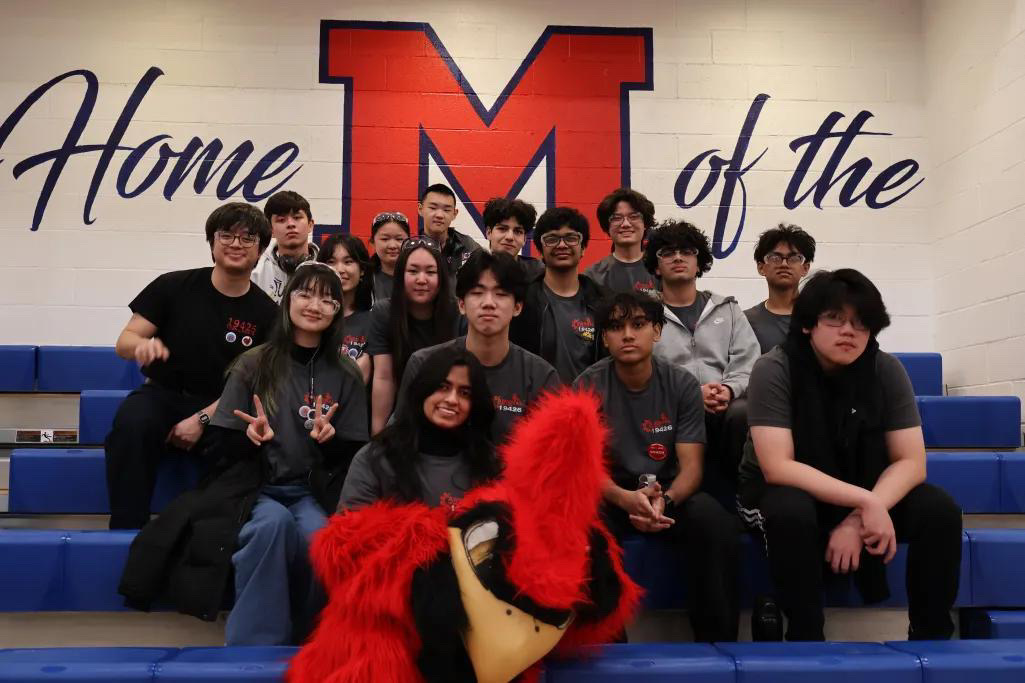
At a surface level, this year’s Science Olympiad’s gender ratio mirrors the overall school’s gender ratio, at around 40% of girls both as applicants and accepted members. However, looking solely at the engineering events, about 34% of those who demonstrated their interest in engineering were girls and only 25% of the members eventually accepted to the engineering events were girls. In the school’s other competitive STEM team, robotics, there is only 1 female member out of 9 total members in the engineering departments of programming or constructions.
Both these teams accept members based on their display of merit and fit. In the Science Olympiad’s application process, an applicant’s ability to study for specific, given topics for their preferred events and their ability to collaborate are emphasized. Meanwhile, robotics emphasizes having experience in the department you’re applying for, critical thinking skills, and problem-solving throughout the application process.
Though these processes are objective and relatively standard, it doesn’t explain the fact that few female students apply to the engineering divisions of QHSS school teams, and even fewer are accepted. Behind this disparity is the impact of the gender inequities in our engineering classes and even before these classes. With girls having unjust experiences in STEM courses, along with the additional impact of being discouraged from exploring their passions in STEM fields, the amount of girls who actually apply to and are successful in self-studying engineering topics or have enough experience to join these competitive teams decreases considerably.
Nearly a third of the members in robotics are girls in the communications department. Nearly half of the members in the non-engineering portions of Science Olympiad are girls. Obviously, there is a strong correlation between representation and interest. The subjects associated with the non-engineering portions of these teams, such as graphic design and non-engineering science subjects like biology, have a much higher representation of women with 50.2% of graphic designers being women and 46% of biological scientists being women. The story sharply shifts with only 16.5% of women making up engineering and architectural fields. There is an obvious need for more representation in engineering. More immediately, there is a need to reduce the disparities in engineering even on the scale of our high school.
Intentionally or unintentionally, the students leading our school teams are doing just that.
Science Olympiad’s engineering events, mostly centering around building an apparatus and then testing its effectiveness, are difficult to evenly divide tasks between members. Often, in the beeline to win a medal, only the experienced are involved in building the apparatus, preventing inexperienced members from learning and having their contributions heard. However, after this disparity and dysfunction became obvious to the board, especially after being brought up by previous members, the board created new protocols within the team to prevent this disparity from continuing in the future. The team captain, Zachary Wong, explains that in the case of an imbalance in distribution, the secretary and team coordinator will step in to ensure that every member is able to practice and learn together.
In robotics, similar disparities have occurred in the past. Robotics competitions usually occur in January or February and require a specific division of tasks.
Because of the additional resources provided in their dedicated space at the Cornell Technology building on Roosevelt Island, most of the development in robotics, especially the more hands-on construction portion, is done there. Meanwhile, members who don’t have past experience in building or programming would mainly practice during the in-school club meetings or complete supervised tasks in Cornell Tech. Last year, in an unfortunate circumstance of scheduling issues and a delayed delivery of parts causing a crunch for time, inexperienced members were unable to add to the robot that would later go on to win a Super Qualifier Tournament, the second tier of competitions in the First Tech Challenge robotics tournaments. Though FTC awarded the uncollaborative and disparity-filled environment within QHSS robotics, the leaders in robotics still plan to restructure robotics to prevent these inequities from occurring in the future. Though robotics leaders noticed these issues occurring in the past, with a senior robotics member noting the extent of these disparities occurring as far back as his sophomore year, the disparities built up to a breaking point last year. Especially after inexperienced members advocated their inability to learn and contribute, robotics leaders responded. They explain, “we officially added being able to go to Cornell Tech regularly to our requirements for admission.” With better plans for scheduling and accountability taken from robotics leaders, the future of robotics holds a promising future filled with collaboration, passion, and likely, more awards.
With the school’s STEM team leaders taking action to disparities in their teams, and members being vocal about the disparities they see, robotics and SciOly offer a bright outlook, especially for the female members in the engineering portions. In a school where students’ excitement to learn and contribute may overshadow girls’ inexperience and underconfidence, it’s essential that we apply these same lessons learned by our STEM teams to our everyday lives.
Starting from our STEM courses, recognize that you or the students around you may have different skill and experience levels because of your background, acknowledge when other students need help and advocate for yourself (but especially for others) when you notice these disparities in your classroom.