






![[The Lunch Table] Dubai Chocolate Syndrome: When You Try to Be Everything at Once](https://qhsscardinalchronicles.com/wp-content/uploads/2026/02/the-lunch-table.png)
![[The Lunch Table] Milk before cereal? School life over social life?](https://qhsscardinalchronicles.com/wp-content/uploads/2026/02/screenshot-2025-10-17-at-9.26.03-pm-1200x1198.png)





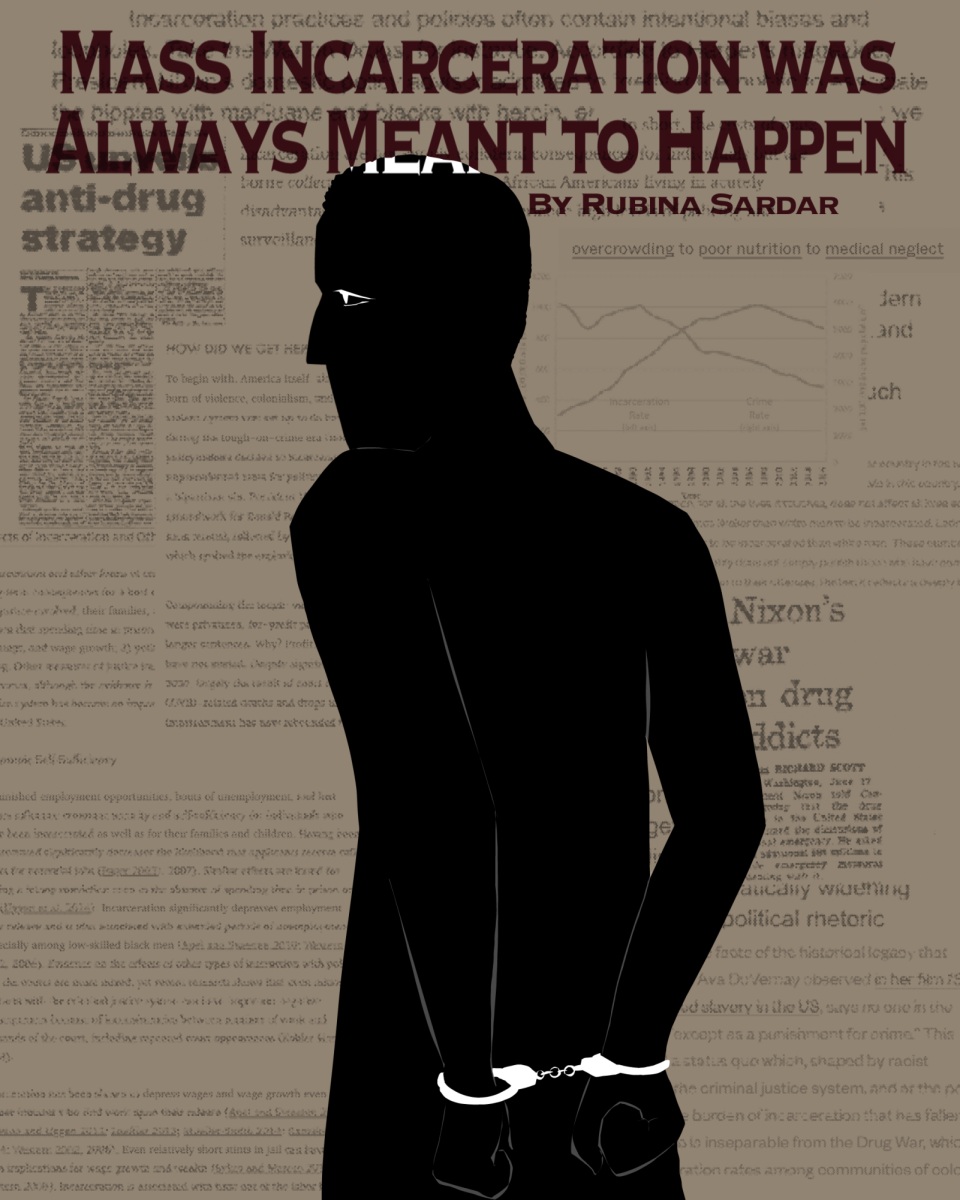







According to The Sentencing Project, The United States has the largest incarceration rates in the world, whilst simultaneously 7 in 10 people in prison are people of color. There is a significant correlation between these two facts as the US government has manufactured this issue through racial discrimination and a string of unfair policy changes, all of which do not in fact target crime. This has been done to further subjugate marginalized communities due to their socioeconomic status, and keep others in positions of power within this country, essentially setting up the prison complex as modern day slavery in which people of color, especially Black people, are disproportionately affected.
Incarceration practices and policies often contain intentional biases and loopholes. Take the War on Drugs, for instance. According to Harper’s magazine, President Nixon’s domestic policy advisor admitted to “getting the public to associate the hippies with marijuana and blacks with heroin, and criminalizing both heavily, we could disrupt those communities. We could arrest their leaders, raid their homes, break up their meetings, and vilify them night after night on the evening news.” This was largely a political strategy to please a conservative base of voters and focus Americans on rising drug use, whilst eliminating political targets.
The War on Drugs was not an isolated misuse of power, but rather a modern expression of a much older system of control embedded in U.S. law. To understand why incarceration in the United States became so expansive and punitive, it is necessary to examine the historical and constitutional foundations that made such policies possible in the first place.
With the 13th Amendment came the abolishment of slavery in the U.S., but a crucial detail highlighted by The Vera Institute and the Innocence Project is left out of most history lessons. The 13th amendment states, “Neither Slavery nor involuntary Servitude, except as punishment for crime whereof the party shall have been duly convicted, shall exist within the United States, or any place subject to their jurisdiction.” The phrase “except as punishment for crime” carved out a constitutional loophole that transformed criminalization into a tool for maintaining racial control, enabling forced labor to continue under the guise of justice and contributing to the expansion of mass incarceration.
The 13th Amendment established a legal foundation that later enabled dramatic increases in incarceration, disproportionately targeting communities of color. Beginning in the 1970s, bipartisan federal policies—including the War on Drugs and other “tough-on-crime” initiatives—expanded this framework, dramatically widening the scope of criminalization and incarceration. At the same time, political rhetoric increasingly linked crime and drug use to specific communities, reinforcing racialized stereotypes and producing lasting social and legal consequences.
These policies are not merely relics of the past; they continue to shape the present. Entire communities have been destabilized by mass incarceration, with families pushed into economic insecurity and children bearing long-term consequences through disrupted education, emotional trauma, and reduced access to opportunity.
Even after release, the punishment rarely ends. Formerly incarcerated individuals face barriers to employment, housing, political participation, and social reintegration—obstacles that are structural. By denying people stability and civic inclusion, the system ensures that incarceration remains cyclical rather than corrective.
If the United States continues to treat imprisonment as a solution rather than a tool of last resort, mass incarceration will persist as a mechanism of racial and economic control. Ending it extends beyond minor policy adjustments. I believe the only way we can truly address it is by confronting the legal loopholes, political incentives, and social narratives that made the system possible in the first place. Until then, justice remains hollow, not because it is unattainable, but because we have chosen not to confront injustice.