



![[The Lunch Table] Dubai Chocolate Syndrome: When You Try to Be Everything at Once](https://qhsscardinalchronicles.com/wp-content/uploads/2026/02/the-lunch-table.png)
![[The Lunch Table] Milk before cereal? School life over social life?](https://qhsscardinalchronicles.com/wp-content/uploads/2026/02/screenshot-2025-10-17-at-9.26.03-pm-1200x1198.png)






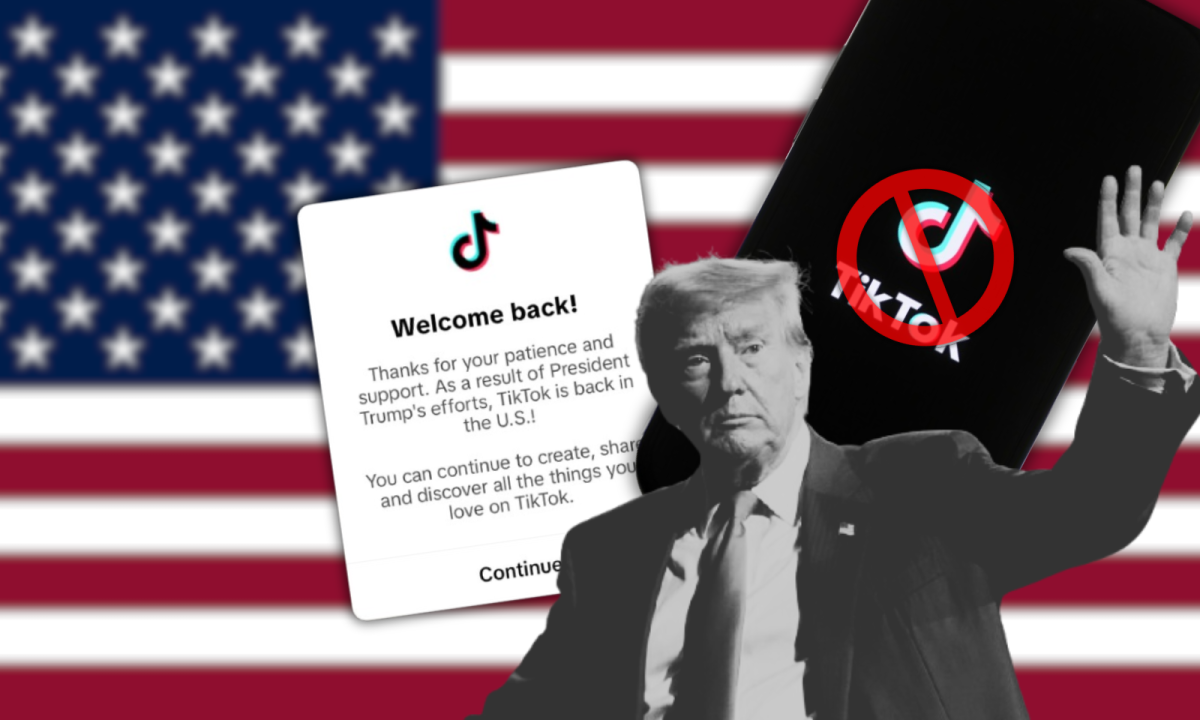
16 million Americans experienced the shut down of TikTok four hours before the intended ban, leaving Americans in an internet outrage. Amidst the 2024 election results, Gen-Z audiences have sarcastically made content pleading for Trump to help in a last resort attempt.
The app briefly came back fourteen hours later, with a pop-up that sparked commotion on its rhetoric. “Thanks for your patience and support. As a result of President Trump’s efforts, TikTok is back in the U.S.!”
American users quickly began praising for his efforts of not only bringing back the beloved social media platform, but also his commitment to the first amendment of free speech. Coincidentally enough, he would be sworn to office the following day, with many Americans tuning into the quadrennial event that is the inauguration and applauding him for his triumphant success of uplifting the short-lived ban.
Since the app emerged on America’s phones after the death of beloved lip-syncing app, Musical.ly, TikTok quickly gained traction to the public for its binge-watching algorithm. With a new social media app comes an influx of internet content, and suspicion quickly rose from politicians and the U.S government on the app for violation of child-protection laws and censorship of Chinese controversies, such as Hong Kong and Tibetan independence content. During Trump’s first presidency, there was a heated legal battle between the president and ByteDance. Trump was overtly against the app and issued an executive order demanding ByteDance to divest from U.S. operations, with the company quickly suing Trump for violation of due process. The ban slowly dissolved as his term came to a close, but the discussion around national security still remained bright, with reports claiming that China-based Bytedance employees were accessing nonpublic information for US TikTok users, and a warning from the FBI of ByteDance sharing TikTok user data with the Chinese government.
The TikTok ban has echoes yet another routine microaggression linked to the Asian American community. Despite constant claims from the government of ByteDance posing as a national security threat to the United States, there hasn’t been any evidence spotted. On July 26, 2024, an affidavit signed by U.S. national security officials, states that there is “no information,” that China has used against the U.S. This perpetuates a strong narrative that Chinese or all Asian people in America are labeled as a national security threat, a narrative that Trump has heavily implied during his first presidency. Through his repeated use of the term “China Virus,” during the global pandemic, Trump consistently displayed anti-asian sentiment on his social media platforms, causing a domino effect of anti-Asian hate crimes during the COVID-19 era.
Fast forward to 2024 — despite ongoing debates over the dangers TikTok poses on national security — Trump was spotted with his own TikTok account, promoting his presidential campaign, in attempts to appeal to young voters. On his Truth Social platform, he urges young voters to vote for him so that TikTok will be “safe.”
From engaging with young voters on TikTok, delaying the ban, to now forming close relations with CEO Shou Zi Chew in saving TikTok, Trump has painted himself as the platform’s savior. From once antagonizing a racial demographic to now endorsing an app who has been accused by the U.S government and numerous politicians of threatening national security, it’s hard to understand where Trump’s morals lie.
However, as Trump takes on his first 100 days of his second term, it’s more clear than ever that his presidency has instilled fear amongst the immigrant community, especially those of the BIPOC community. Amongst his countless, head-inducing executive orders, one that had many astonished was the executive order that aims to end birthright citizenship in a nation arguably the most diverse in the world. On top of this, ICE raids have been at an all time high, with Trump permitting agents easier access to public buildings, such as schools and hospitals.
Among his countless executive orders and bills signed, not a single one outlined his actions towards the TikTok ban.
The internet has sparked commotion on Trump’s attempts to change America into an oligarchical government, where he sits as an evangelical leader to the public. Trump’s efforts to temporarily uplift the ban envelops his true intentions for the nation, setting a dangerous precedent as he enters the first one hundred days in office.