


![[The Lunch Table] Dubai Chocolate Syndrome: When You Try to Be Everything at Once](https://qhsscardinalchronicles.com/wp-content/uploads/2026/02/the-lunch-table.png)
![[The Lunch Table] Milk before cereal? School life over social life?](https://qhsscardinalchronicles.com/wp-content/uploads/2026/02/screenshot-2025-10-17-at-9.26.03-pm-1200x1198.png)












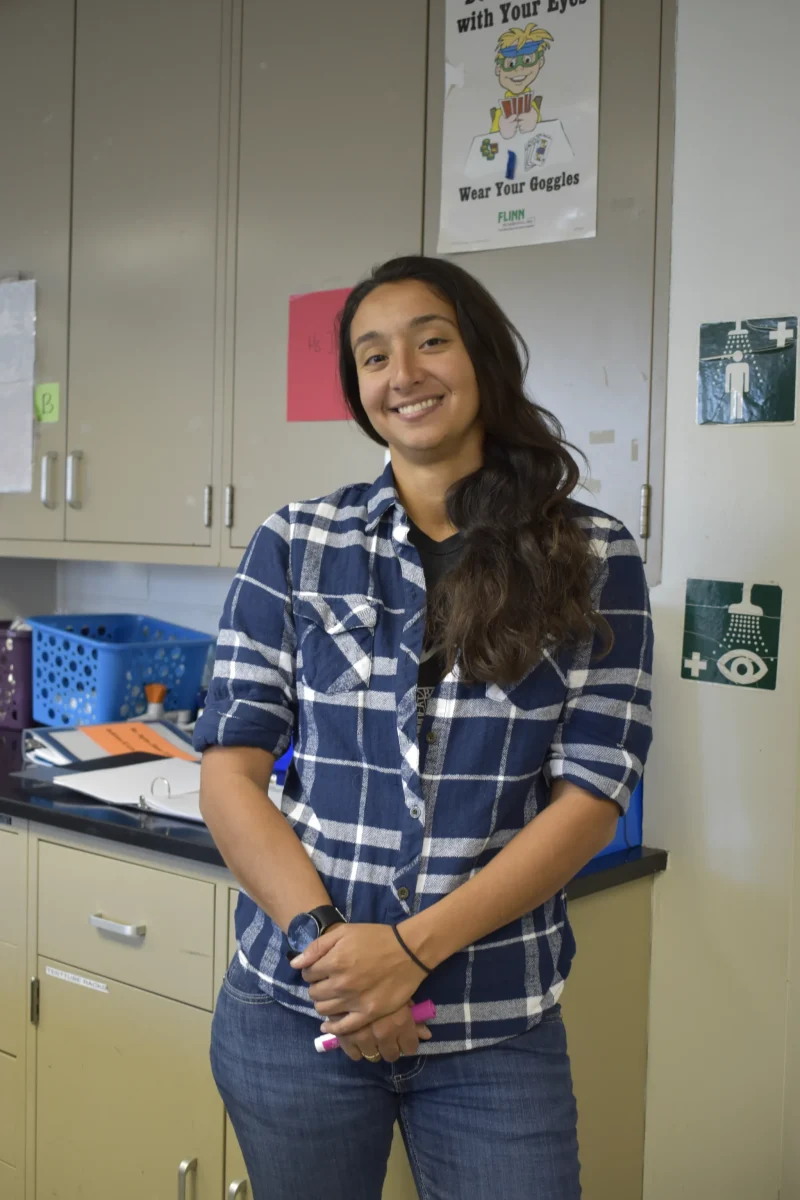
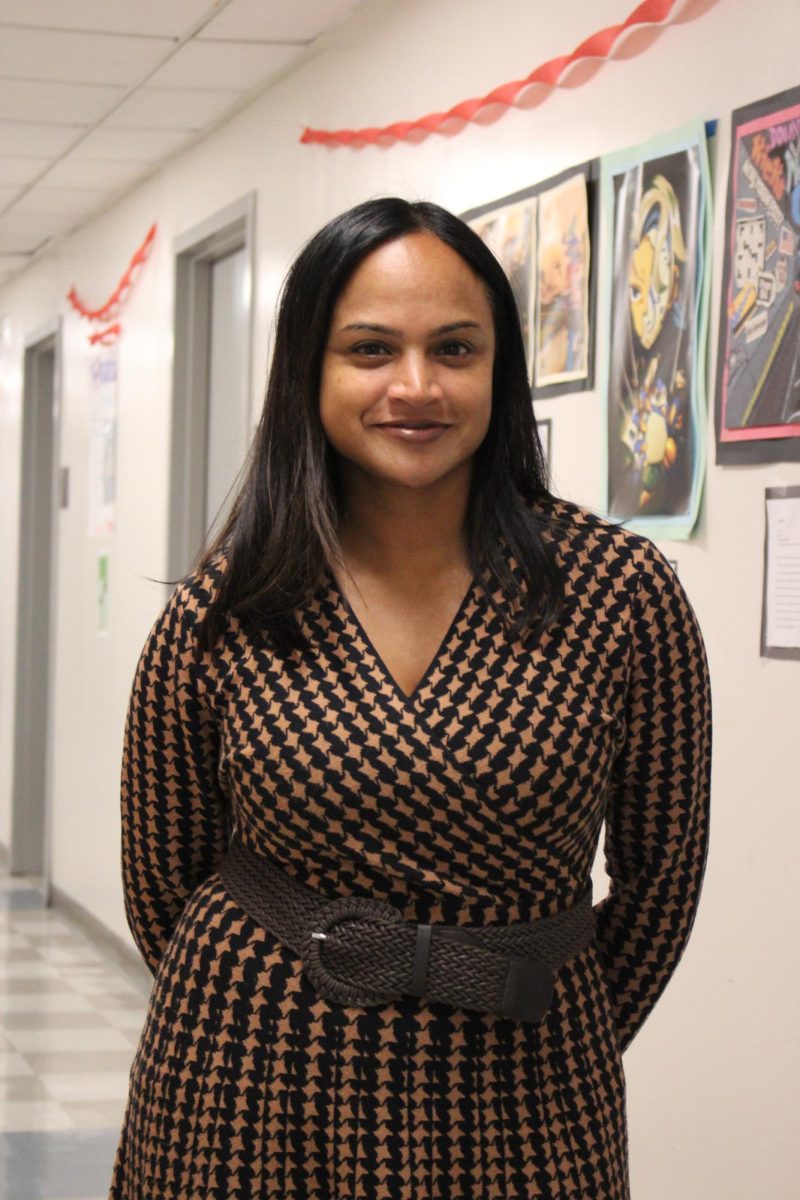
As the month of September was greeted by chilly winds, the scent of pumpkin spice in the air, and vibrant orange leaves, students transitioned from their lazy summer days back into the fast-paced rhythm of school. Amongst the fresh supplies students bought, they also noticed a fresh set of faces within the classrooms. A wave of new teachers had arrived, but one name quickly stood out: Ms. Leavy.
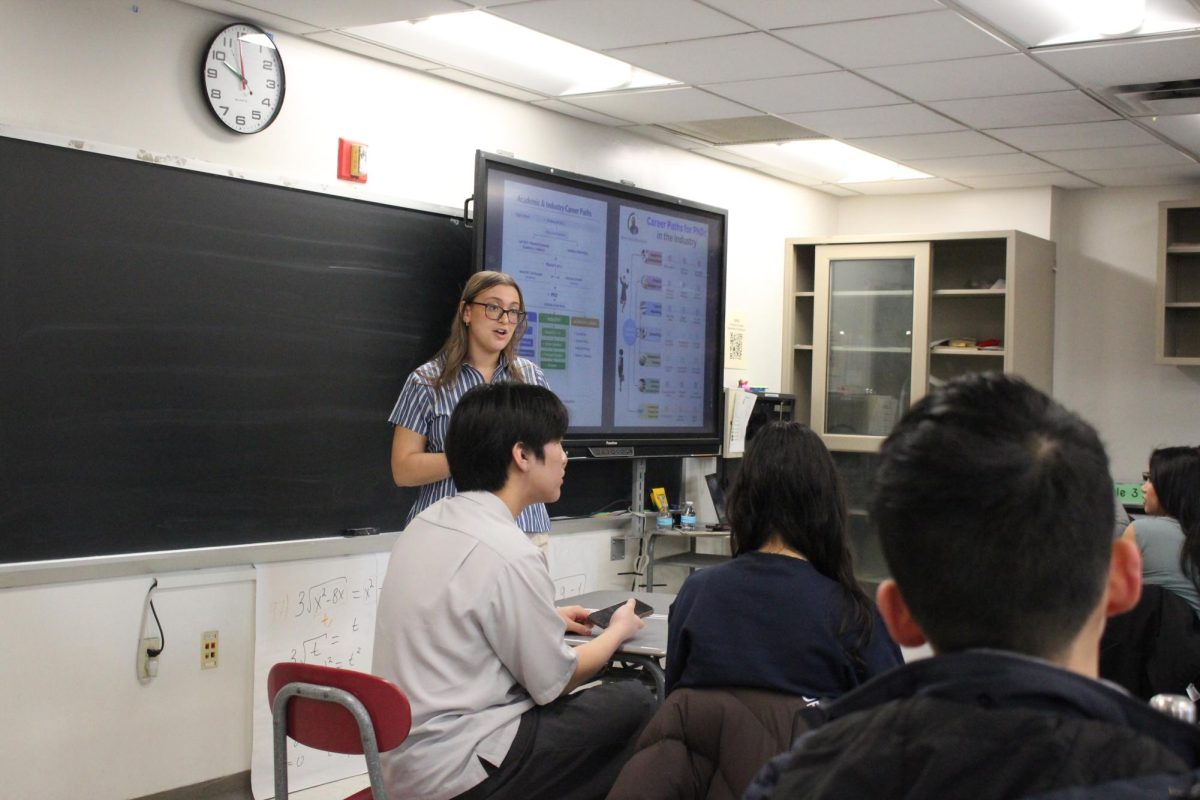
Taking over both the Anatomy and Physiology and AP Biology classes while simultaneously stepping into key administrative duties once handled by Mr. Rutcofsky, Ms. Leavy quickly became a defining presence at QHSS.
With an extensive teaching background, Ms. Leavy shared that while this is her first year at QHSS, it marks her 10th year of full-time teaching. She explained how Dr. DeJesus reached out to her over the summer with an opportunity to join the school. After being interviewed over the summer, Ms. Leavy was invited to join the school to take on roles in test coordination and instructional leadership, alongside teaching.
Her journey to becoming a teacher was as rigorous as the courses she now teaches. Ms. Leavy began her academic career at Fordham University, where she was able graduate in just three years (thanks to the numerous AP exams and college-level courses she took in high school). Though she could have finished earlier, she chose to enjoy her final year with friends. During her senior year, she began exploring career options and was encouraged to consider law school. She applied to St. John’s University and earned a full scholarship.
While attending law school, Ms. Leavy also pursued a master’s degree in special education, balancing both graduate programs without either school knowing that she was enrolled in the other. She managed to complete her master’s degree over three years, while still attending law school, and graduated with both degrees—law and special education—just one week apart.
To support herself during this time, she substituted in schools within Brooklyn, gaining valuable teaching experience while also working internships in various areas of law. One of her internships was with the city legal department, where she worked on lawsuits ranging from property damage to police brutality cases. This experience gave her a deep understanding of the legal process, the police department and how they interact with NY citizens.
Ms. Leavy’s legal background remains an active part of her life. She still works independently in landlord-tenant law, specifically in real estate, for friends and family. However, her passion for teaching remains strong. She’s also considered a legal career within education, noting that many lawyers within the Department of Education work in areas such as protecting student rights, handling cases related to suspensions, and addressing lawsuits about school safety violations. “There are many options within the DOE that aren’t just teaching,” she explained.
When asked if she might pursue this path in the future, Ms. Leavy emphasized her open-minded approach to new opportunities. “I never say no to anything,” she said. “Whenever an interesting opportunity presented itself, I always tried my best to take it on if it was possible.”
An example of Ms. Leavy’s philosophy in action is her biology research in Namibia, Africa, where she focused on cheetah genetics. During her time working on her biology master’s degree, alongside teaching at her previous school, she had the opportunity to travel abroad and contribute to important conservation efforts.
She collaborated with Dr. Laurie Marker, the founder and current director of the Cheetah Conservation Fund, along with a team focused on addressing the challenges of the small breeding population of cheetahs. Ms. Leavy’s work included collecting samples, conducting game counts for property assessments, and helping reduce predator conflicts and poaching through the use of trained dogs. The team’s primary goal was to determine the most effective strategies for captive breeding to ensure genetic diversity in the cheetah population, working hard to prevent their extinction.
Ms. Leavy also actively continues conservation work locally in the United States. She shared that she began hunting after completing her master’s degree, inspired by Dr. Laurie Marker’s perspective that one of the most important things we can do for wildlife is to hunt animals ethically and manage their populations.
During hunting season, from October to February, Ms. Leavy participates in archery, rifle, and gun hunts, often in areas where hunting is needed to control overpopulated wildlife. “We are paid to hunt on properties owned by towns to reduce wildlife numbers because they’re so overpopulated,” she explained. “We’re trying to avoid issues like starvation, car accidents, and the spread of diseases like Lyme disease.” She also noted that excessive deer populations can increase the risk of disease transmission, such as zombie deer which entails deers wasting away and suffering death by starvation. “Though it may sound counterintuitive, we’re killing the deer to help the deer and protect people,” Ms. Leavy concluded.
Outside of hunting, she expressed her interests in cooking—specifically, bread making—and training her German Shepherd for a Schutzhund competition. It is a dog sport originally developed in Germany to test the working abilities of German Shepherds. Specifically, it tests dogs’ ability to follow commands, track scents, and protect their handler in various scenarios. Competitions range from being held at local to international levels.
In the U.S., Schutzhund is commonly used by breeders who supply dogs for police departments or military purposes. Ms. Leavy shared that her dog’s breeder works with the corrections department out west, and some of her dog’s siblings have gone on to serve in police departments for search and rescue operations.
“Down the road, if my dog passes her exams, I would be open to continuing her bloodline for that purpose,” Ms. Leavy explained. “Not every German Shepherd has the capacity for this work. My dog’s parents both passed their exams with high scores, but not all of their puppies will make it. My dog seems to be on the right track, but we won’t know for sure until later—we’ll probably test her over the summer.”
While Ms. Leavy’s work with dogs reflects her dedication to discipline, her personal tastes reveal a more free-flowing side to her personality. Some students are already aware of her enjoyment for Charli XCX, creating a relatable connection between her and her students. However, Ms. Leavy shared that her music taste is far from exclusive to one genre. “I have a very eclectic taste. If you go through my Spotify, it’s all over the place, and when it’s on shuffle, it often irritates my friends and family. It will go from new metal to espresso to country, and I’ve gone to every type of concert under the sun.”
When recommending music for students, she suggests Fleetwood Mac, “because they’re often categorized as ‘old people music,’ but they’re amazing. I am Stevie Nicks’ number one fan. If she has zero fans, I am the only one left on earth. I’ve seen her in concert six times, so I definitely think everyone should listen to Fleetwood Mac.”
As for reading, Ms. Leavy describes herself as an “average reader” who particularly enjoys history. One of her favorite books is Through the Brazilian Wilderness by Theodore Roosevelt, her favorite president. The book chronicles his dangerous journey down the previously unexplored River of Doubt in the Amazon, a trip where he almost died.
As for sports, surprisingly, In high school, Ms. Leavy also earned her black belt in jujitsu at 18. Although she hasn’t kept up with it due to injuries, she encourages others to try it. “It’s an active sport, and surprisingly more analytical than people think. It’s not just physical; it really gets you thinking.”
While her interests and experiences showcase the depth of her personality, it’s biology that truly drives her in the classroom. Ms. Leavy shared that biology has always been her favorite subject to teach. “I think biology is always my favorite just because the concepts are so real and kids can see them in their life and make connections. It’s not abstract. For example, if I explain a mathematical principle in algebra, it’s not as immediately interesting as saying, ‘Hey, check out a peacock. Why does it have these features?’ And suddenly, students are engaged and thinking, ‘Wow, that’s a good question!’”
Her favorite topic to teach is natural selection. “It’s interesting to see what it’s created in the world around us and to see how it happened.”
Harboring many roles throughout her personal and professional life, Ms. Leavy attributes much of her success to her strong organizational skills. “I’m a big fan of paper calendars. I keep one on my desk where I write down everything that’s happening and when it happened, even if it’s something in the past. I believe in the power of writing it down. I can walk into my office every morning and immediately see what’s ahead, and what’s already occurred. It’s all physically in front of me. At home, I even have a giant version on my dining room table,” she explained. She even considered a chalkboard wall in her bedroom but was told it would make the space too dark.
However, she humorously also admitted, “I wasn’t always like this—especially in high school. I was a disaster. My AP English teacher definitely didn’t enjoy how disorganized I was. She flat out said, ‘I don’t understand how you keep your grades up with the way your backpack looks.’ Sorry, Sister Nora, but I’m better now. I used to have one folder, one notebook—everything just jumbled together. My teachers hated it. They were like, ‘This is not how you should be functioning.’”
Ms. Leavy has even reconnected with a few of her old teachers. “Some of them know what I’m doing now. One of my old teachers stopped teaching and was working at the law school I attended. I was in the library one day, and someone tapped me on the shoulder. It was her, and she said, ‘What are you doing here?’ And I said, ‘What are you doing here?” So I have kept in contact with some teachers, not all, but some do know my career trajectory.”
From her extensive career background to her unique passions, Ms. Leavy is the embodiment of passion and discipline. Her journey reminds us that success comes from the willingness to embrace new opportunities and learn along the way. As she continues to teach at QHSS, the Cardinal Chronicles give her a warm welcome.